
From Chaos to Clarity – Organising Digital Case Management
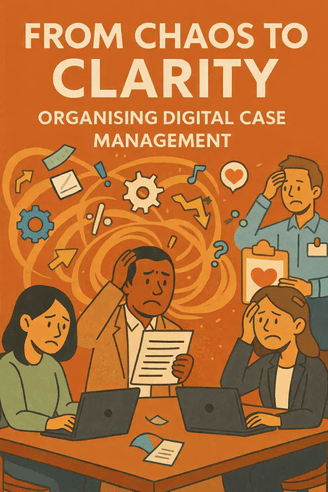
Most services don’t begin in chaos.
They begin with structure, clear processes, defined forms and shared understanding. But over time, complexity increases, caseloads grow, new requirements are added, additional spreadsheets appear and different teams adapt the system slightly differently to make the work flow.
Individually, each adjustment makes sense.
Collectively, they create noise.
Information becomes harder to locate.
Reports take longer to reconcile.
Supervision relies more on explanation than visibility.
Confidence in the record softens — not dramatically, but gradually.
That’s when digital case management stops feeling organised and starts feeling busy.
Clarity doesn’t come from adding more fields or more rules.
It comes from alignment.
When case activity is recorded in a consistent, structured way — and stored in one coherent place — the narrative becomes visible. Patterns emerge. Risk histories are easier to follow. Oversight becomes grounded in shared information rather than interpretation.
From a governance perspective, that matters.
From a practitioner perspective, it matters even more.
When systems reduce fragmentation and duplication, they lower cognitive load. Recording feels purposeful. Information supports the work instead of interrupting it.
Moving from chaos to clarity isn’t about perfection.
It’s about creating a digital environment where information is organised, trusted, and usable — so that decisions are made with confidence and services can focus on what they’re there to do.
That shift is often quieter than people expect.
But its impact is significant.