
When the World Cup Begins, Violence Against Women and Girls Quietly Rises
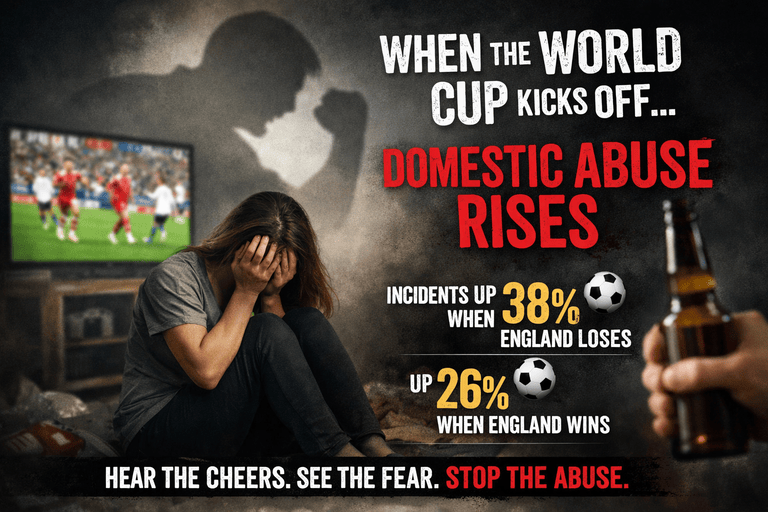
The World Cup is sold as a moment of unity, a shared national celebration. But behind closed doors, the data tells a different story. For thousands of women and girls across England, major football tournaments are periods of heightened risk.
Research analysing previous World Cups found that domestic abuse incidents rose by 38% when England lost, and 26% when England won. Even draws saw increases. Police forces across England have reported the same pattern for over a decade: match days consistently correlate with spikes in call‑outs, arrests and high‑risk incidents.
This isn’t because football causes abuse. It’s because perpetrators already using control or violence become more volatile in high‑intensity environments. Alcohol consumption rises sharply on match days. Emotional highs and lows are amplified. Gambling losses add pressure. And perpetrators often use the match result as justification for their behaviour.
For women and girls living with coercive control, this means a familiar routine: monitoring mood changes, avoiding conflict, keeping children quiet, preparing for the fallout. While the country celebrates, many families brace themselves.
The impact is measurable across the system:
Police forces report surges in domestic abuse call‑outs during tournaments.
Helplines see increased demand, especially after evening fixtures.
Refuges operate with reduced capacity as more families seek safety.
IDVA and ISVA services face more complex, higher‑risk caseloads.
Children’s services record higher levels of exposure to harm.
These aren’t isolated spikes - they’re predictable pressure points. And predictable patterns demand planned responses.
At Halo, we see these trends reflected in the data professionals record every day. When incidents rise, so does the need for accurate information‑sharing, early risk identification and coordinated multi‑agency action. The ability to spot escalation quickly and act on it - becomes critical.
Football doesn’t create perpetrators.
But tournaments expose the cracks in the systems meant to keep women and girls safe.
As the World Cup approaches, we need to prepare, not react. That means:
Recognising the evidence that abuse rises during tournaments
Ensuring specialist services have the capacity to respond
Strengthening multi‑agency coordination
Making clear that alcohol, stress or football are never excuses for violence
Using data intelligently to identify risk earlier and intervene sooner
Domestic abuse doesn’t pause for the World Cup.
And neither should our response.